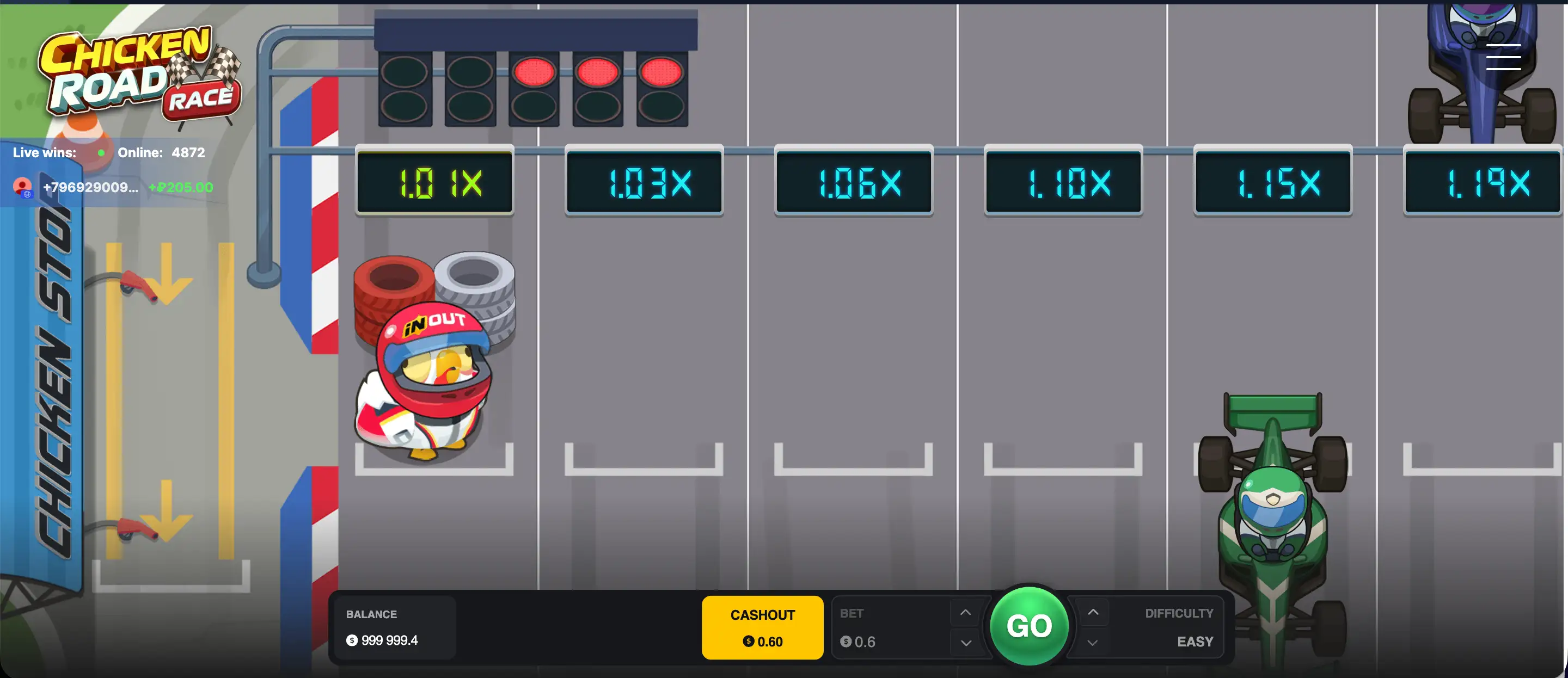
Chicken Road Race isn't your typical slot—it's a high-volatility crash-style game where understanding the multiplier system and bankroll discipline are the only real "strategies." Forget guaranteed wins; this guide cuts through the hype to explain how the game actually works, what your odds truly are, and how to avoid the most common (and costly) mistakes players make during a session.
Advantages
Simple, intuitive crash mechanics with manual cash-out control
Multiple difficulty modes (Easy, Medium, Hard, Hardcore) for risk customization
Provably Fair RNG system ensures transparent randomness
Low minimum stakes (from $0.01) suitable for all bankrolls
Fast-paced rounds ideal for short sessions
Maximum multiplier potential up to 3,203,384x in Hardcore mode
Disadvantages
High volatility means frequent losses in rapid succession
No skill-based element—outcomes are purely random
RTP decreases sharply in harder modes (down to 60% in Hardcore)
Psychological trap: greed often leads to mistimed cash-outs
Negative expected value over time favors the house
Chicken Road Race Quick Facts
Game Type
Crash-style multiplier
RTP
96–98% (varies by operator)
Volatility
Very High
Min Bet
$0.01–$0.20
Max Bet
$100–$200
Max Multiplier
Up to 3,203,384x (Hardcore)
Auto Cash-Out
Yes
Mobile/App
Full browser support
How Chicken Road Race Works: Rules and Mechanics
Chicken Road Race follows the core logic of crash games: a round starts, a multiplier begins at 1.00x and increases continuously, and players must decide when to cash out. If you cash out before the "crash" (the chicken gets hit), you win your bet multiplied by the current value. If you don't cash out in time, you lose your stake.
The game's outcome is determined by a certified Random Number Generator (RNG), ensuring each round is independent. Past results—like a string of early crashes—do not make a high multiplier "due." This is the gambler's fallacy, and it's the fastest way to deplete a bankroll.
1. Select Your Difficulty Level
Choose from Easy (24 safe tiles, 96% RTP), Medium (22 tiles, 88% RTP), Hard (20 tiles, 80% RTP), or Hardcore (15 tiles, 60% RTP). Higher difficulty means bigger potential multipliers but drastically lower odds.
2. Place Your Bet
Set your stake between $0.01 and $200. Start with smaller bets (1-2% of session bankroll) to manage volatility and extend playtime.
3. Start the Round
Press "Play" to initialize the grid. The chicken begins crossing, and the multiplier starts climbing from the base value (x1.02 in Easy mode, up to x1.63 in Hardcore).
4. Navigate Tile by Tile
Click "Go" to advance one tile. Each safe step increases the multiplier. Monitor the multiplier carefully—decide in advance at what level you will cash out (e.g., 2x or 3x) to lock in consistent small wins.
5. Cash Out or Lose
Press "Cash Out" at any moment to secure your current winnings. If you land on a fire tile, the round ends instantly and your bet is lost. Timing discipline is the only real strategy.
Understanding the Multiplier System and RTP in Chicken Road Race
The multiplier is the heart of the game, but it's crucial to understand its relationship with the game's Return to Player (RTP) and your expected value (EV).
Like all casino games, Chicken Road Race has a built-in house edge. Its RTP is a long-term average (e.g., 96%) and does not guarantee your personal return. This means for every $100 wagered over millions of rounds, the game pays back $96 on average. In a single session, you can easily be far above or below that.
Your Expected Value (EV) is negative. For a game with a 96% RTP, the house edge is 4%. On a $10 bet, your long-term expected loss is $0.40 per round. The high-volatility nature means you might hit a 50x multiplier once, but you're far more likely to experience frequent small losses that steadily erode your bankroll.
Bankroll Management and Betting Tactics for Chicken Road Race
There is no betting system that can overcome the house edge in Chicken Road Race. Systems like the Martingale (doubling your bet after a loss) are particularly dangerous here, as a short losing streak can wipe out your entire bankroll.
Instead, focus on responsible bankroll management:
Set a Session Budget: Decide on a fixed amount you are willing to lose before you start playing. This is your total session bankroll.
Choose a Fixed Bet Size: Your bet should be a small, consistent percentage of your session bankroll (e.g., 1-2%). Never increase your bet to chase losses.
Set a Cash-Out Target: Decide on a multiplier you are happy with (e.g., 2x or 3x) and stick to it. This turns the game into a series of small, positive-expectation decisions. It helps you lock in frequent small wins and avoid the devastating loss of greed.
Use Platform Safety Tools: Enable deposit limits, loss limits, and session time reminders offered by the platform. These are your best defense against impulsive play.
Recommended Bankroll Strategies by Difficulty
Difficulty
Recommended Bet Size
Cash-Out Target
Session Budget (50 bets)
Risk Level
Easy
1-2% of bankroll
1.5x - 2x
$50 - $100
Low
Medium
1% of bankroll
2x - 3x
$100 - $150
Medium
Hard
0.5% of bankroll
3x - 5x
$200+
High
Hardcore
0.5% or less
5x - 10x
$500+
Extreme
Common Player Mistakes and How to Avoid Them
Most losses in Chicken Road Race come from psychological traps, not bad luck. Here are the most common mistakes:
Chasing Losses: After a loss, players often increase their bet size dramatically in an attempt to win back their money quickly. This almost always leads to a larger, unrecoverable loss.
Ignoring the House Edge: Believing that a "hot streak" or a "cold streak" changes the odds of the next round. The RNG has no memory; each round is a fresh, independent event.
Playing Without a Plan: Jumping in without a predetermined bet size, cash-out target, or session limit. This leads to impulsive, emotional decisions.
Misunderstanding Volatility: Expecting frequent large wins. High-volatility games like this are designed for infrequent, large payouts, funded by a constant stream of small losses from the majority of players.
Over-Confident After Demo Play: Demo mode does not reflect real variance. Players often move to real stakes expecting the same streak patterns, only to face rapid losses when variance normalizes.
Is Chicken Road Race a Safe and Fair Game to Play?
The fairness of Chicken Road Race depends entirely on the platform hosting it. To ensure a safe experience:
Check the License: Only play on sites licensed by reputable jurisdictions (e.g., UKGC, MGA). A license from Curaçao is common but offers weaker player protection.
Look for RNG Certification: The game should be certified as fair by an independent testing laboratory like iTech Labs or eCOGRA. This ensures the outcomes are truly random.
Read the Terms & Conditions: Understand the platform's rules on bonuses, withdrawals, and account verification before you deposit.
License, Security & Responsible Gaming
Provably Fair RNG
Chicken Road Race uses certified Random Number Generation to ensure each round is independent and transparent. Seed generation can be verified by players on platforms that support Provably Fair systems.
Platform Security
Play only on SSL-encrypted platforms licensed by recognized authorities. Check for HTTPS protocol, valid licensing footer, and certification seals from testing labs.
Responsible Gaming Tools
Enable deposit limits, loss limits, session time reminders, and self-exclusion options. Set hard stop-loss amounts before each session and never exceed them.
Age Restriction
You must be 18+ (or the legal gambling age in your jurisdiction) to play. KYC verification is required before your first withdrawal to prevent underage gambling.
4.2/5
Expert Verdict
Chicken Road Race is a well-executed crash game with transparent mechanics and Provably Fair RNG. The multiple difficulty modes allow risk customization, and the manual cash-out system gives players full control. However, the steep house edge in harder modes (up to 40% in Hardcore) and the psychological trap of greed make disciplined bankroll management essential.
FAQ
Frequently Asked Questions
The maximum multiplier depends on difficulty: x24.5 in Easy mode, x2,254 in Medium, x52,067 in Hard, and up to x3,203,384 in Hardcore mode. However, higher multipliers come with exponentially lower probability.
Easy mode (96% RTP, 24 safe tiles) is recommended for beginners. It offers the highest return rate and allows you to learn the game mechanics without extreme volatility.
No. Martingale and similar progression systems do not overcome the house edge and are extremely dangerous in high-volatility games. A short losing streak can exhaust your entire bankroll.
Provably Fair uses cryptographic hashing to generate each round's outcome before the round starts. Players can verify that the server seed, client seed, and nonce produce the displayed result.
Minimum bet is typically $0.01, making the game accessible to low-stakes players. Maximum bet is usually $200, though this may vary by platform.
Hardcore mode (60% RTP) has only 15 safe tiles versus 24 in Easy mode. The extreme house edge (40%) is the mathematical cost of the massive maximum multiplier potential.
Yes. Demo mode helps you understand the interface, timing, and multiplier behavior without financial risk. However, do not assume demo variance reflects real play.
Enable deposit limits, loss limits, and session time reminders on your platform. Set a hard stop-loss before each session and never exceed it.